CadrentoLet’s talk
← All examples

Illustrative examples

Business services

Briefs, proposals and deliverables: content about choosing and working with service providers.

10 examples · 6 formats. Demonstration content, not a client case study or a promise of results.

Browse all 10 examples
  1. What should you tell a contractor about the job?
  2. Two quotes have the same price. What’s included?
  3. What should you tell a contractor before asking for a quote?
  4. What will you get when the work is done?
  5. What should you agree on before hiring a service provider?
  6. Two proposals look alike. What should you compare?
  7. What should a contractor know before you send a task?
  8. What Will You Receive When the Work Is Finished?
  9. Ready to send your brief?
  10. How do you know what you’re hiring a contractor to do?

01 / Text post

What should you tell a contractor about the job?

A short project brief can put the job's basics in one place. Asana suggests covering your goal, who the work is for, what's included, and your timeline.

Threads version

What should you tell a contractor about the job?

A short project brief can put the basics in one place. Asana suggests covering your goal, who the work is for, what's included, and your timeline.

Write your goal in one sentence.

Bluesky version

What should you tell a contractor about the job?

A short project brief can put the basics in one place. Asana suggests covering your goal, who the work is for, what's included, and your timeline.

Write your goal in one sentence.

Example call to action

Write your goal in one sentence.

02 / Text post

Two quotes have the same price. What’s included?

Set the tasks and deliverables each quote lists side by side. Then ask how each contractor handles revisions. A matching price alone doesn't answer either question.

Threads version

Two quotes show the same price. Do they include the same work? Compare their listed tasks and deliverables. Ask how each contractor handles revisions.

Mark one missing detail.

Bluesky version

Two quotes show the same price. Do they include the same work? Compare their listed tasks and deliverables. Ask how each contractor handles revisions.

Mark one missing detail.

Example call to action

Mark one missing detail.

03 / Post

What should you tell a contractor before asking for a quote?

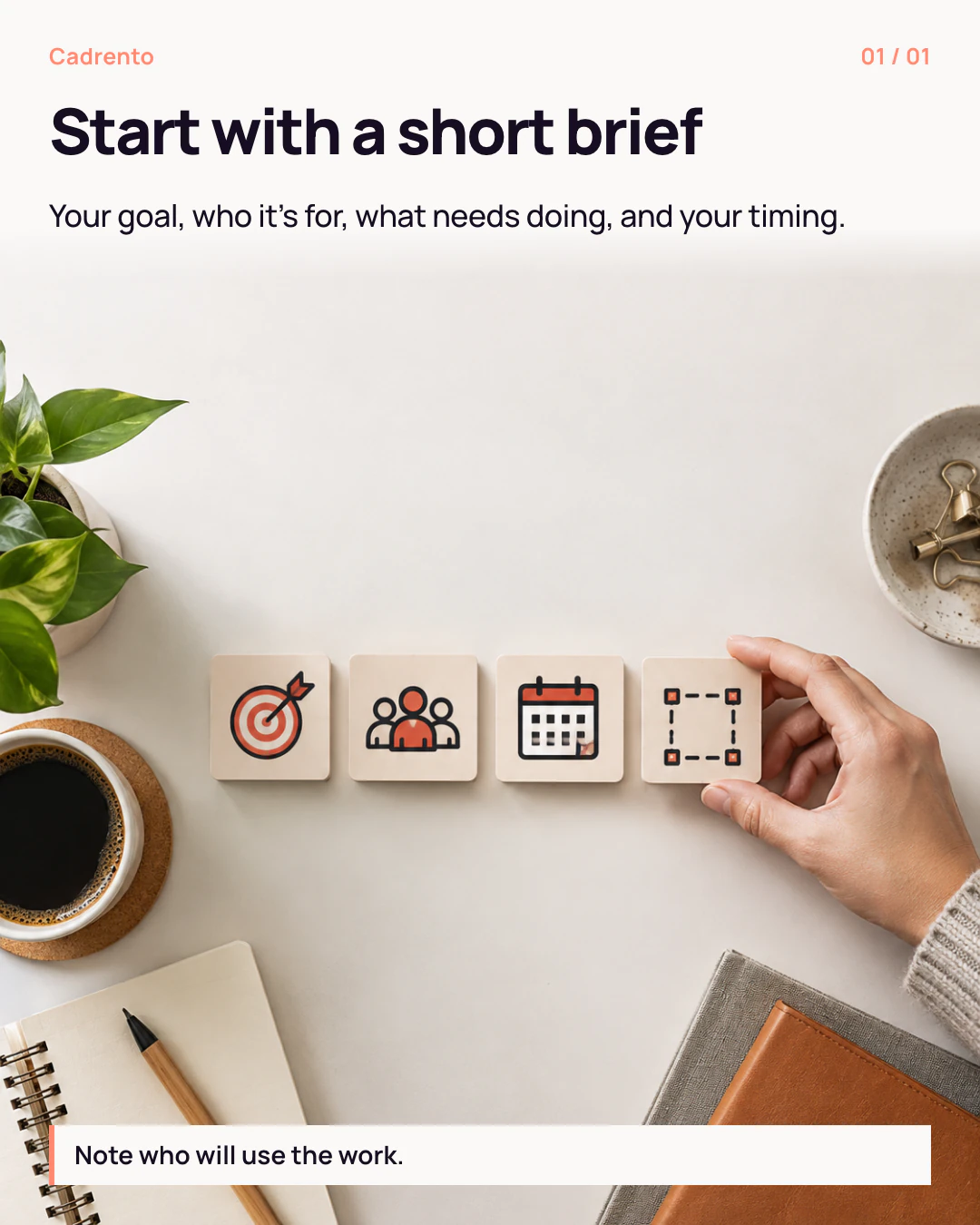
Planned overhead view of a tabletop: a hand places a work-area icon tile beside target, people, and calendar icon tiles. Space above is left for the headline.
Read caption

Before you ask a contractor for a quote, put the basics in one short brief. Asana suggests including your goal, who the work is for, what needs doing, and your timing. These are useful starting points, not a fixed rule. Add what you expect to receive so the contractor knows what you’re asking for.

Read text

Your goal, who it’s for, what needs doing, and your timing.

Example call to action

Note who will use the work.

04 / Post

What will you get when the work is done?

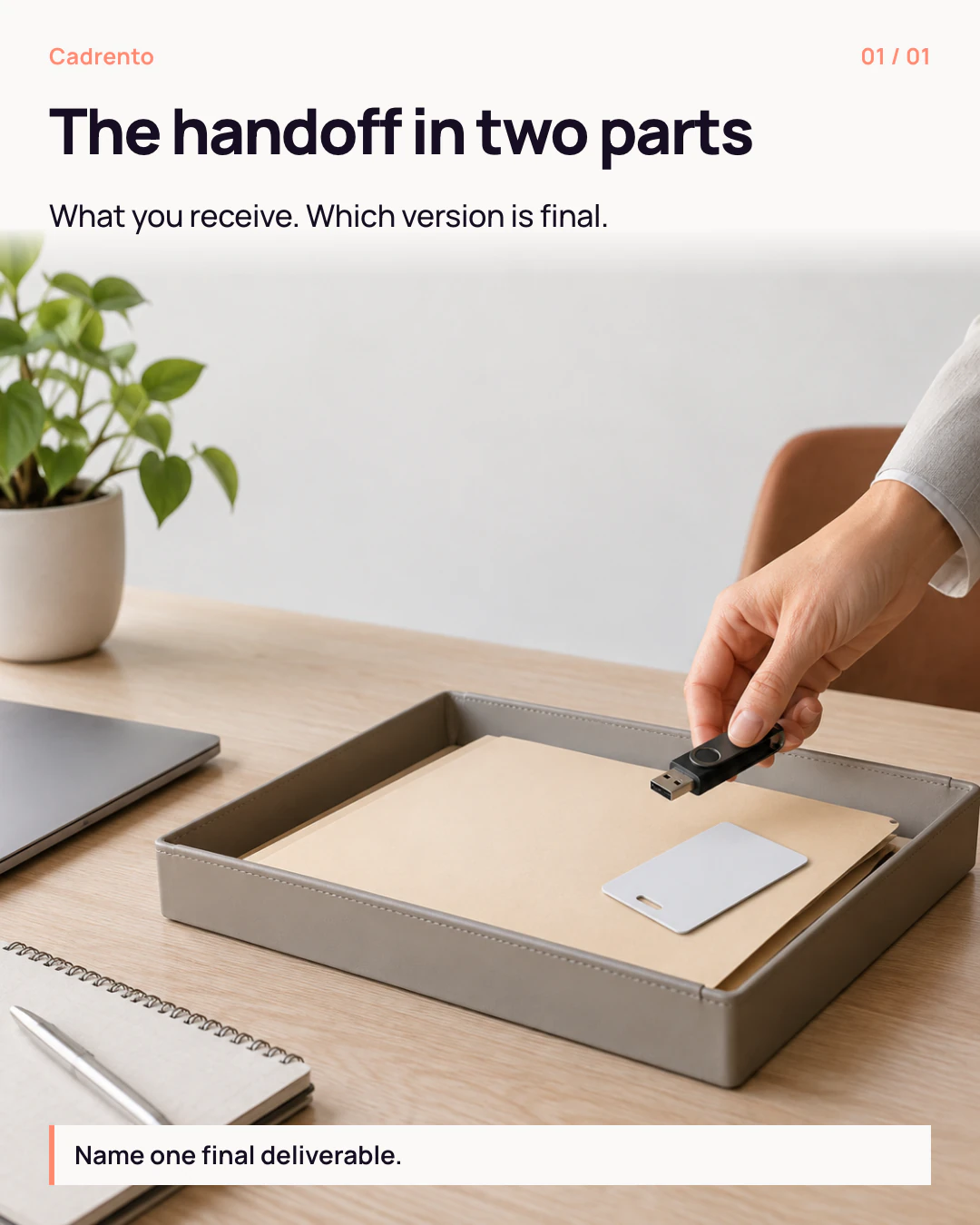
Planned tabletop scene: a hand places an unmarked USB drive, plain folder, and blank access card into a shallow tray.
Read caption

A project brief can keep your goals and scope in one place. You can also use it to list the files, access, or materials you expect to receive and specify which version counts as final.

Read text

What you receive. Which version is final.

Example call to action

Name one final deliverable.

05 / Carousel

What should you agree on before hiring a service provider?

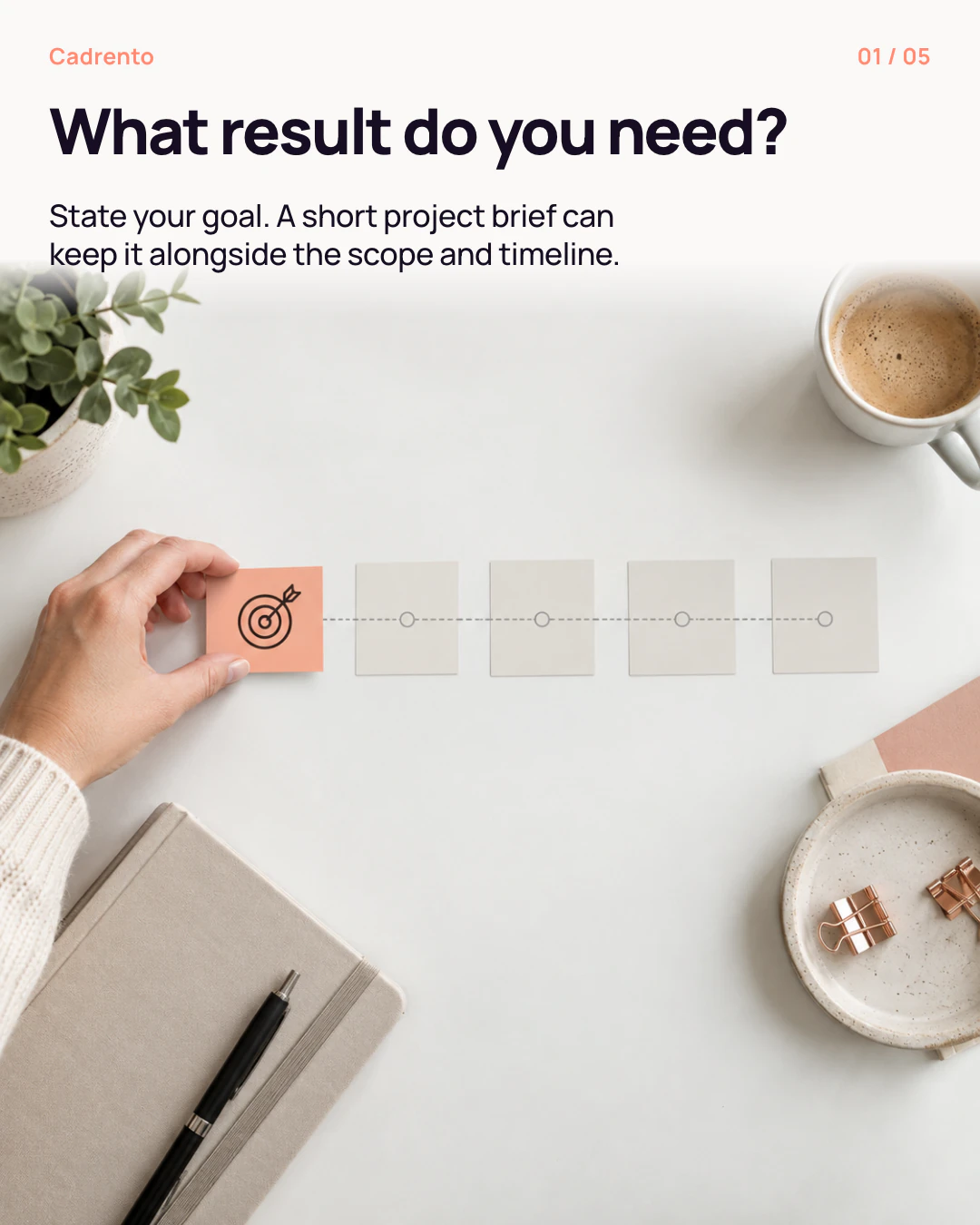
  1. Overhead view of a desk: a hand places a target icon at the first stop on a path of five blank cards. The other stops are faint.
    Slide 1 of 5What result do you need?

    State your goal. A short project brief can keep it alongside the scope and timeline.

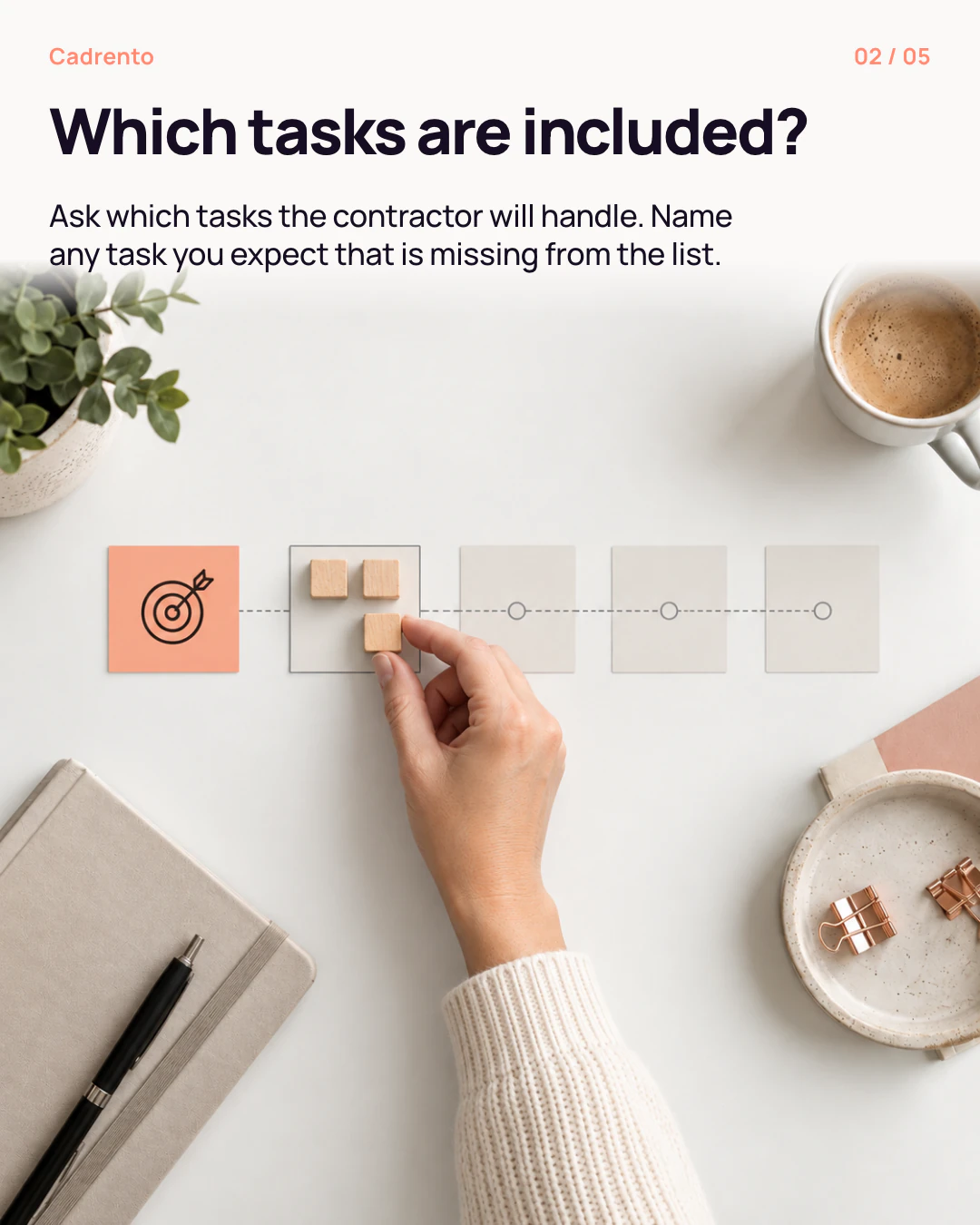
  2. On the same desk, a hand places one of three wooden task blocks inside a thin boundary at the second stop. The target icon remains visible farther back.
    Slide 2 of 5Which tasks are included?

    Ask which tasks the contractor will handle. Name any task you expect that is missing from the list.

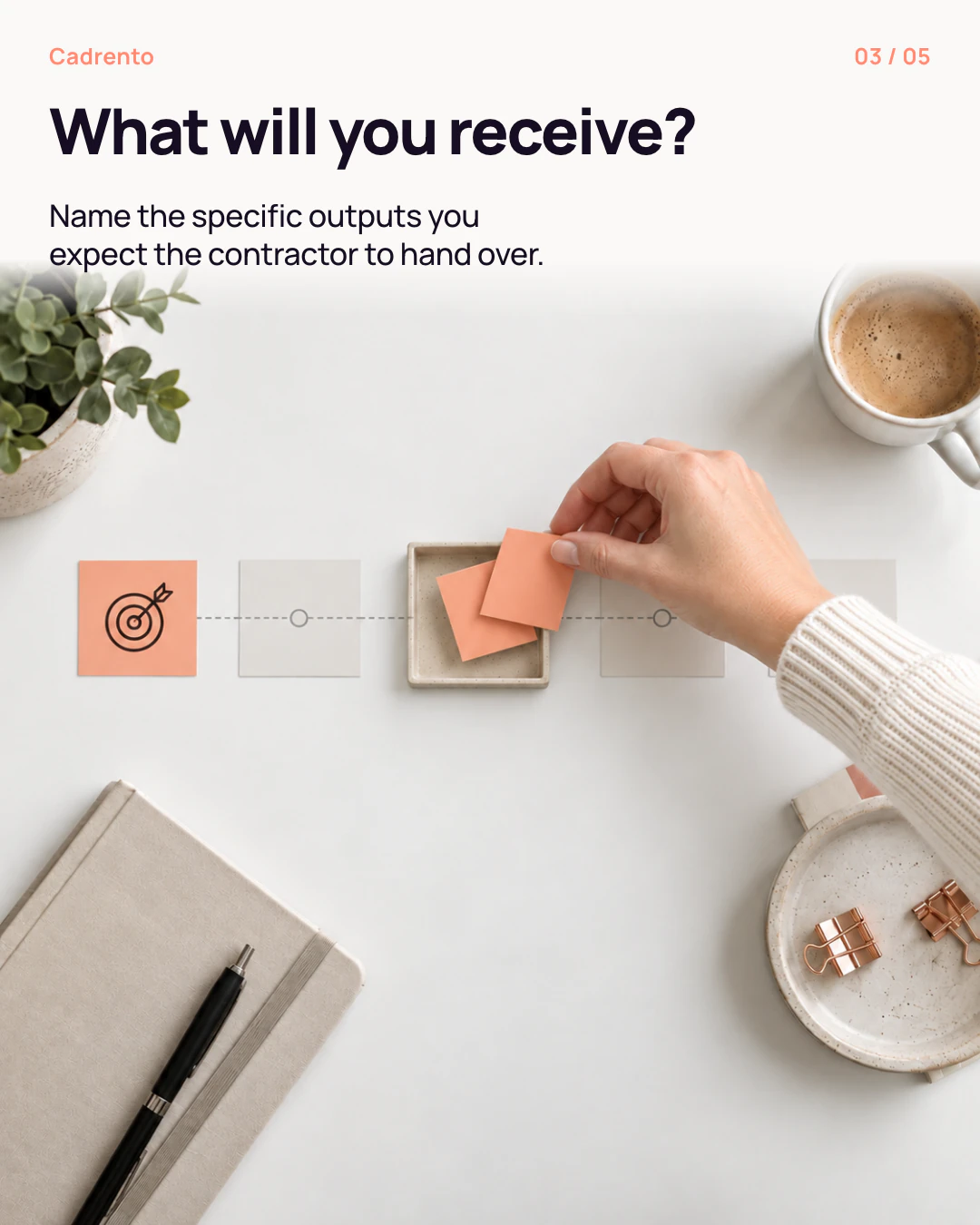
  3. A hand moves two plain, unmarked output tokens from the task boundary into an open tray at the third stop.
    Slide 3 of 5What will you receive?

    Name the specific outputs you expect the contractor to hand over.

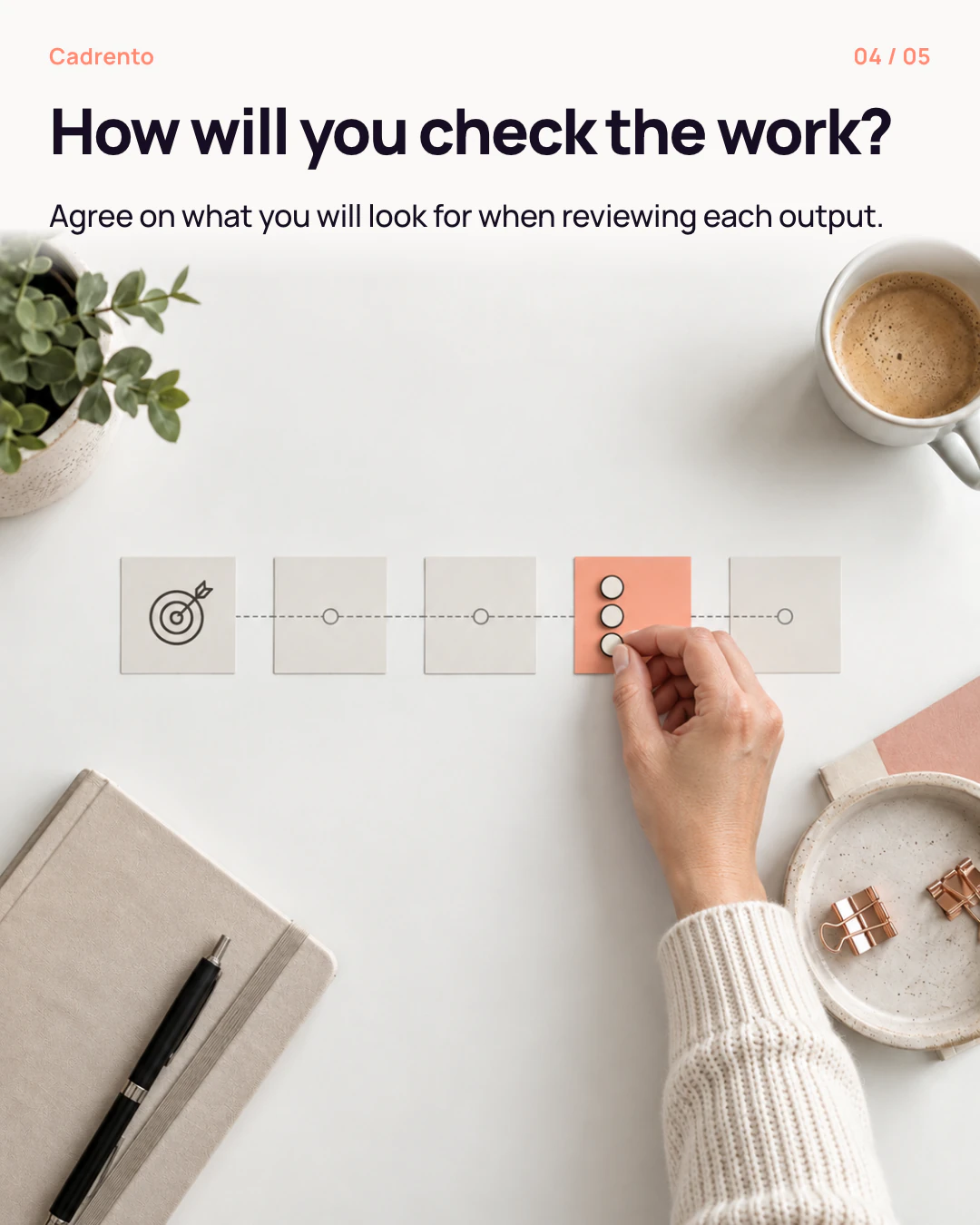
  4. A hand aligns three empty geometric check markers beside the output tray at the fourth stop.
    Slide 4 of 5How will you check the work?

    Agree on what you will look for when reviewing each output.

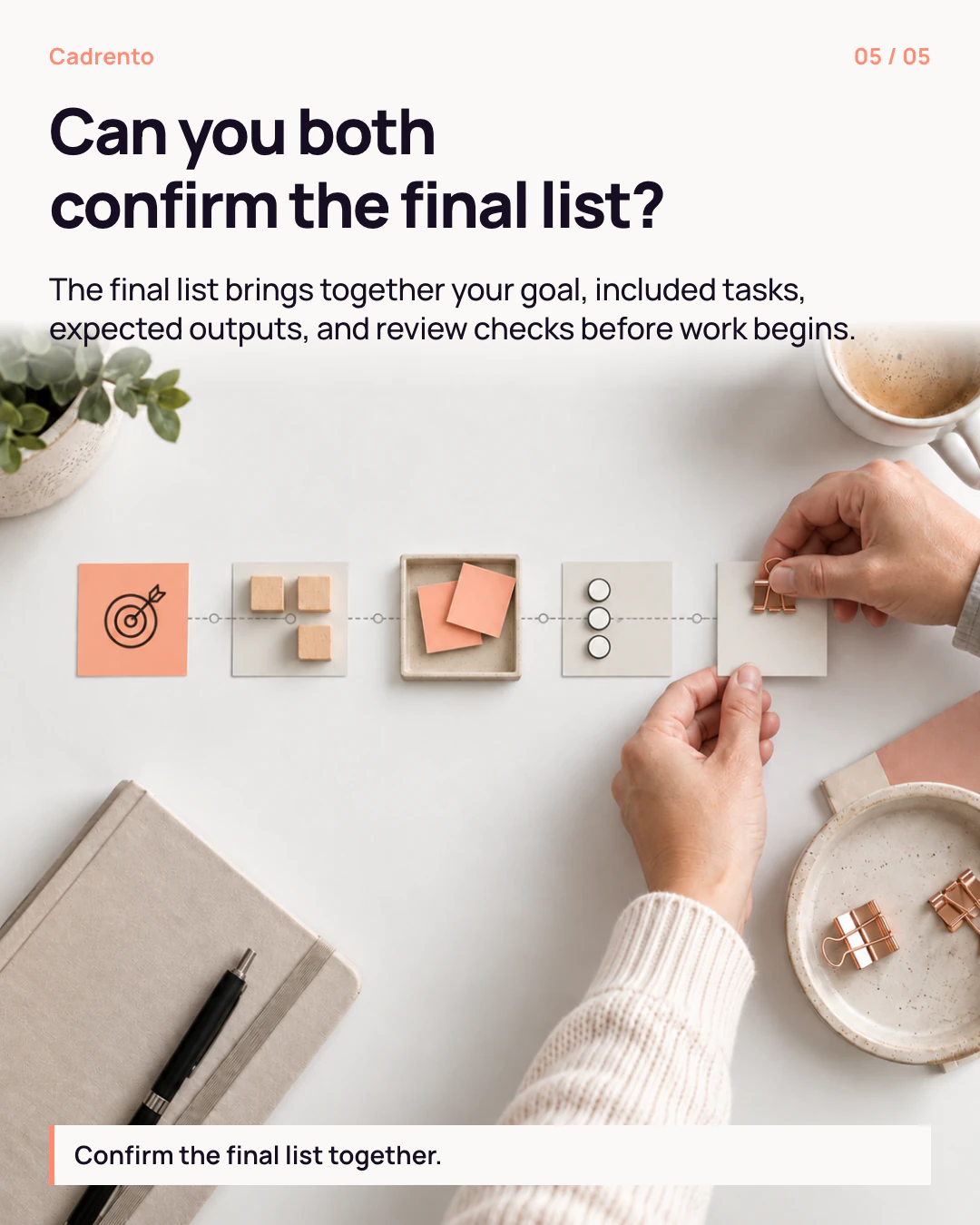
  5. Two hands meet over the fifth blank card and place a simple clip on it. The target, task boundary, output tray, and check markers form a path behind it.
    Slide 5 of 5Can you both confirm the final list?

    The final list brings together your goal, included tasks, expected outputs, and review checks before work begins.

Read caption

A short project brief can put your goal, scope, timeline, and audience in one place. Use it to discuss the included tasks, expected outputs, and how you’ll check the work. Confirm the final list together.

Read text

What result do you need? State your goal. A short project brief can keep it alongside the scope and timeline.

Which tasks are included? Ask which tasks the contractor will handle. Name any task you expect that is missing from the list.

What will you receive? Name the specific outputs you expect the contractor to hand over.

How will you check the work? Agree on what you will look for when reviewing each output.

Can you both confirm the final list? The final list brings together your goal, included tasks, expected outputs, and review checks before work begins.

Instagram caption

If you’re choosing a contractor, start with the result you need. Ask what work is included, what you’ll receive, and how you’ll check it. Confirm the final list together.

Example call to action

Confirm the final list together.

06 / Carousel

Two proposals look alike. What should you compare?

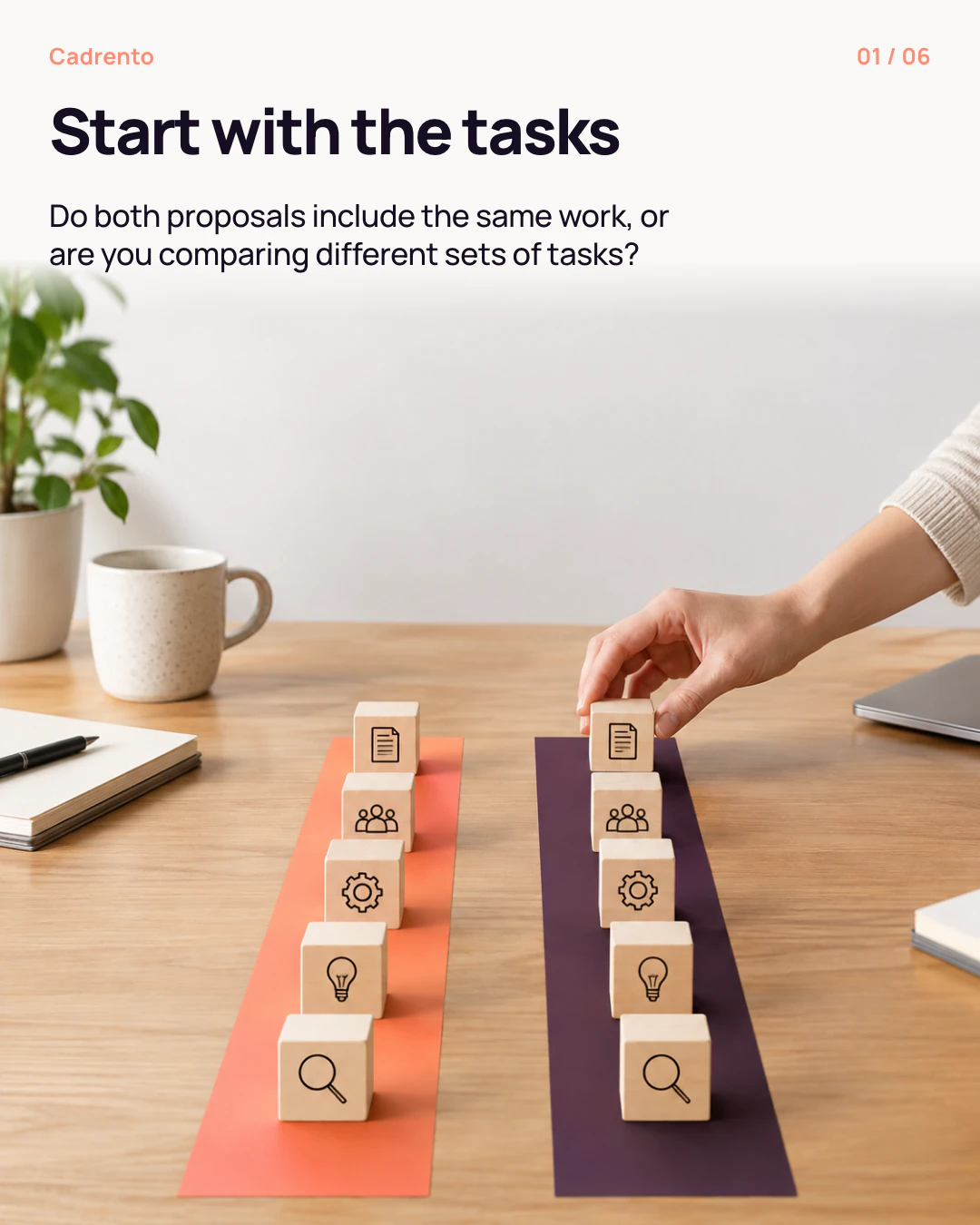
  1. On a tabletop, a hand aligns small task blocks along two parallel, color-coded rows.
    Slide 1 of 6Start with the tasks

    Do both proposals include the same work, or are you comparing different sets of tasks?

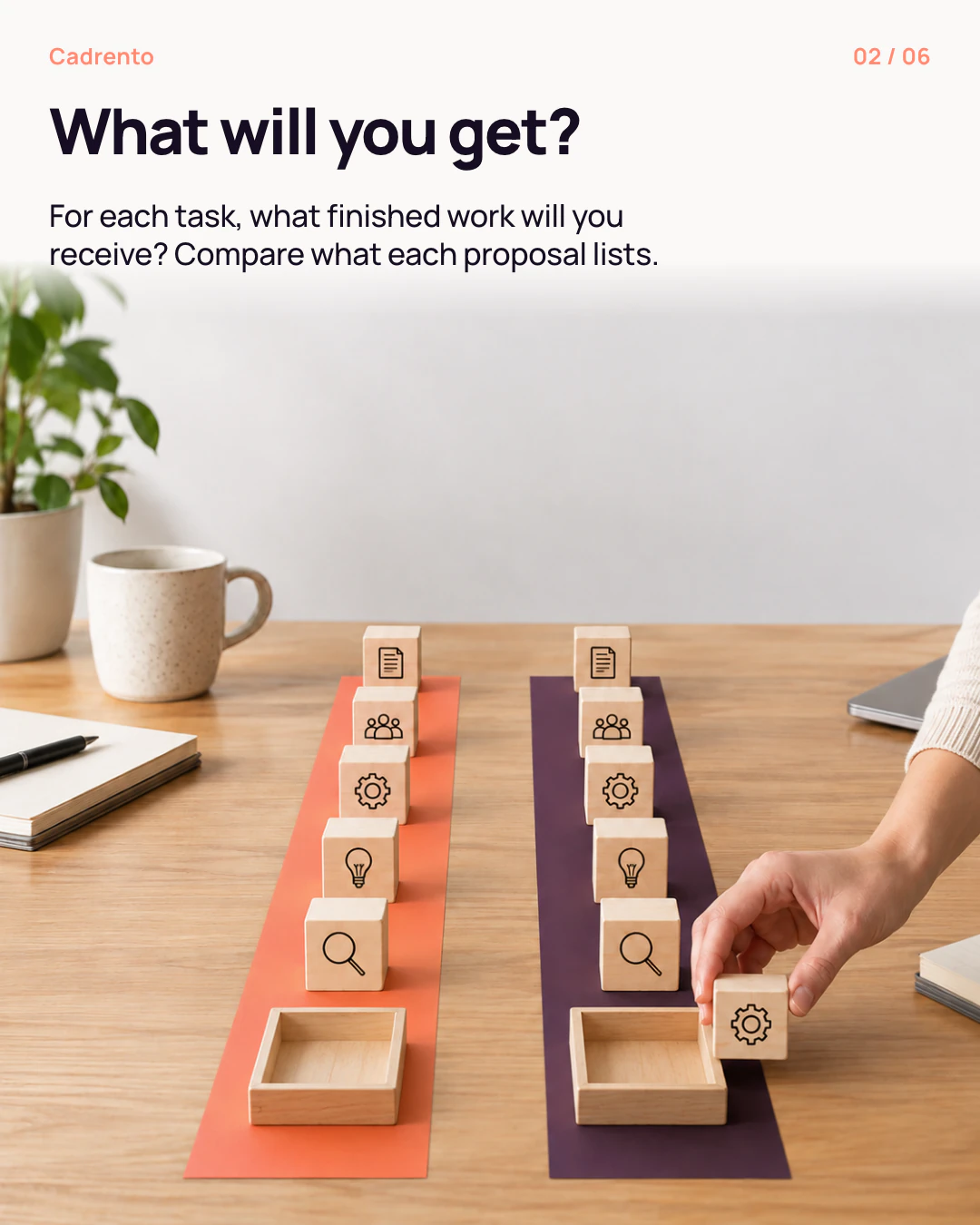
  2. Two color-coded rows end at empty trays. A hand places generic output tokens beside them.
    Slide 2 of 6What will you get?

    For each task, what finished work will you receive? Compare what each proposal lists.

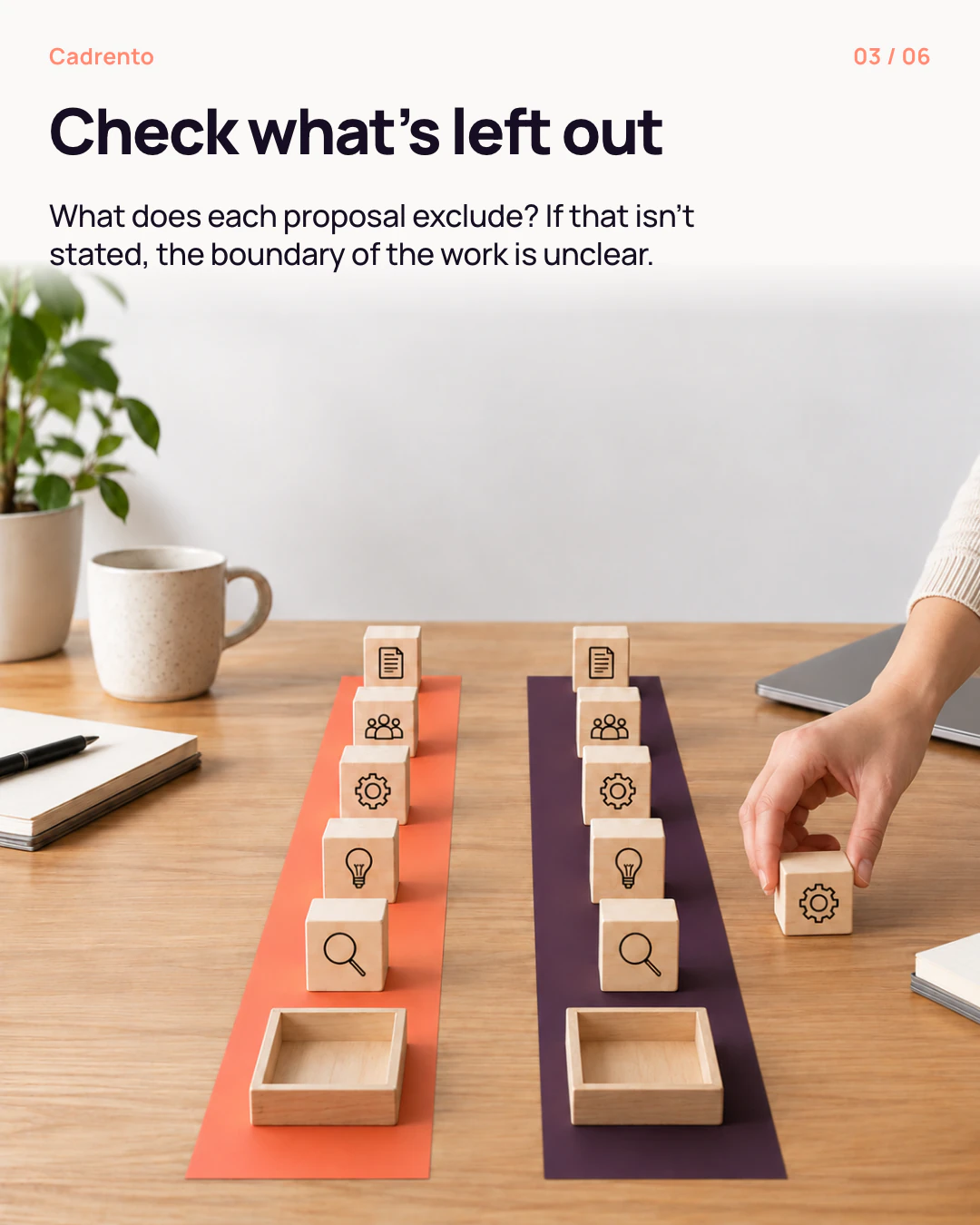
  3. Two colored boundary frames sit side by side. A hand places a neutral block outside one frame.
    Slide 3 of 6Check what’s left out

    What does each proposal exclude? If that isn’t stated, the boundary of the work is unclear.

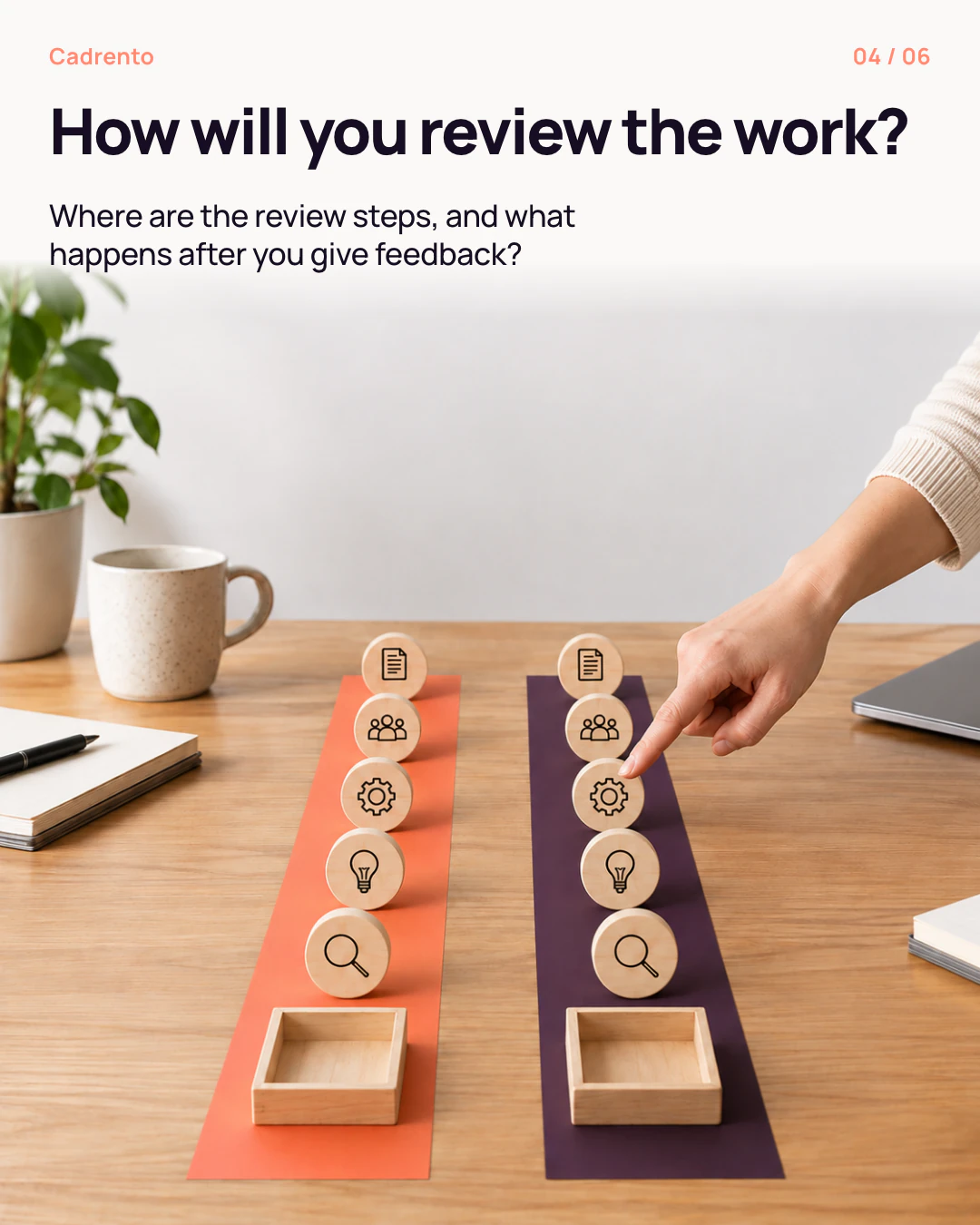
  4. A hand points between circular review markers on two parallel paths.
    Slide 4 of 6How will you review the work?

    Where are the review steps, and what happens after you give feedback?

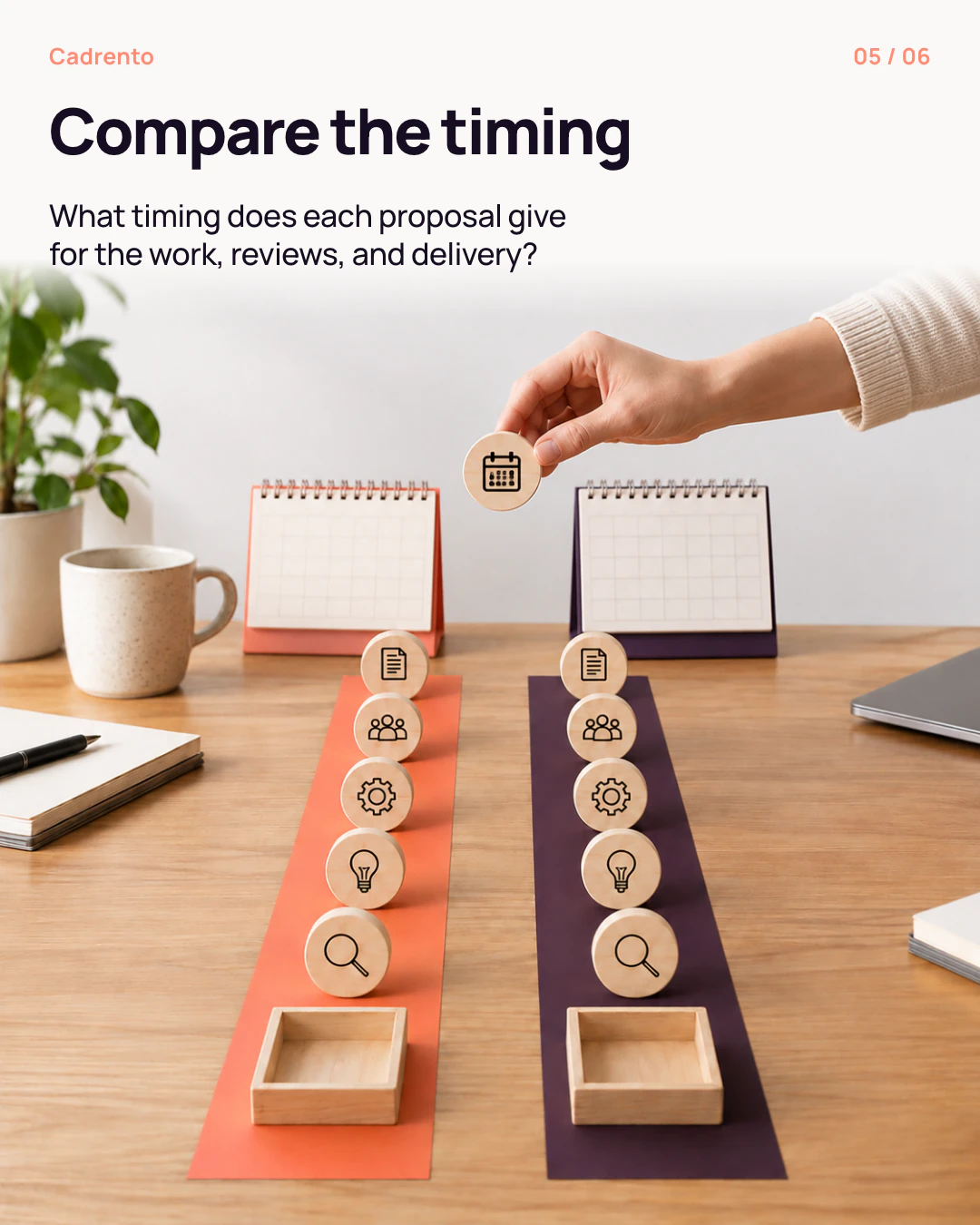
  5. Two plain desk calendars sit beside the colored rows. A hand holds a blank date marker between them.
    Slide 5 of 6Compare the timing

    What timing does each proposal give for the work, reviews, and delivery?

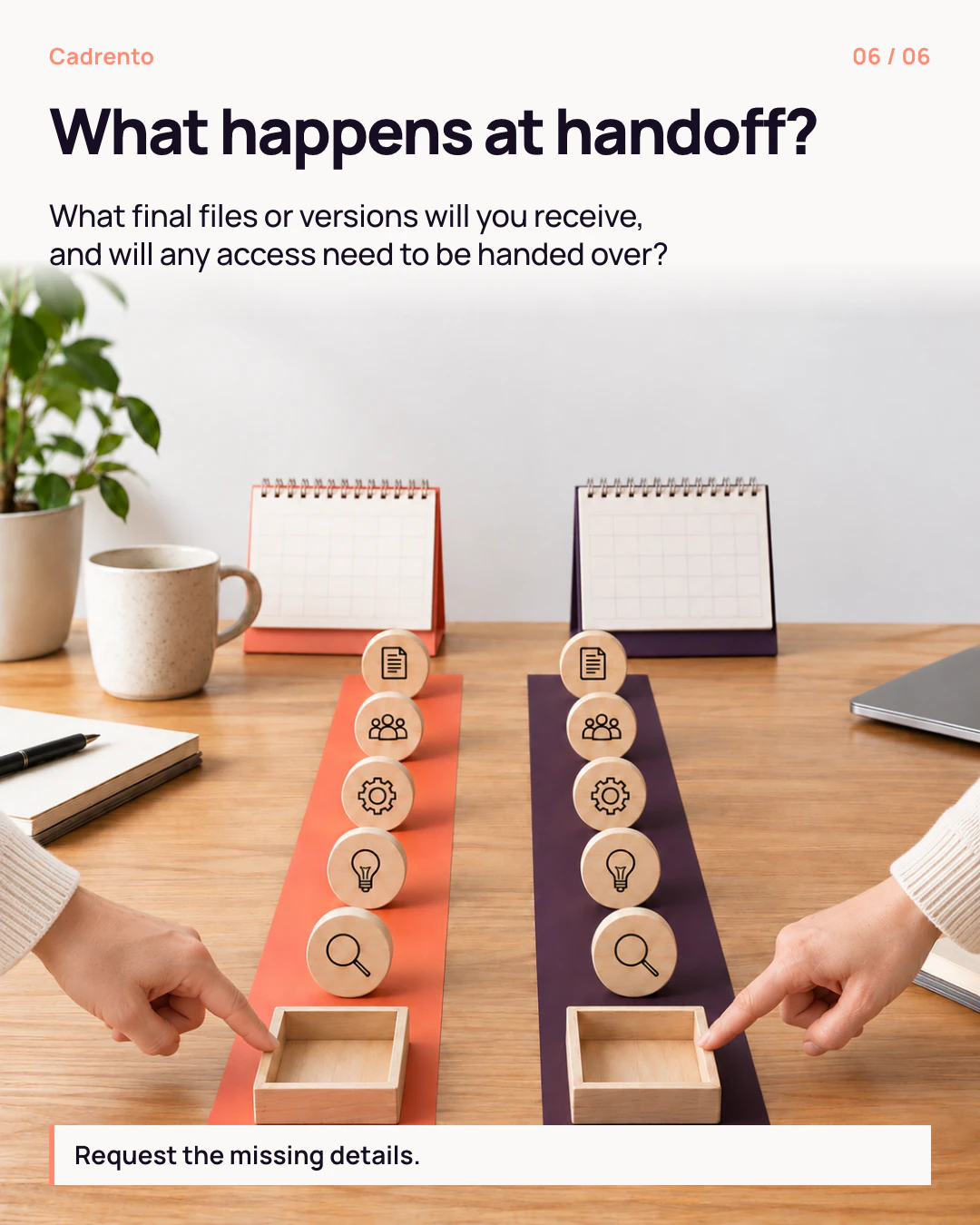
  6. Two identical empty handoff boxes sit at the ends of the rows. A hand points toward their openings.
    Slide 6 of 6What happens at handoff?

    What final files or versions will you receive, and will any access need to be handed over?

Read caption

If two prices look close, you still need to know whether the proposals describe the same work. These six areas give you a way to read them side by side.

Read text

Start with the tasks Do both proposals include the same work, or are you comparing different sets of tasks?

What will you get? For each task, what finished work will you receive? Compare what each proposal lists.

Check what’s left out What does each proposal exclude? If that isn’t stated, the boundary of the work is unclear.

How will you review the work? Where are the review steps, and what happens after you give feedback?

Compare the timing What timing does each proposal give for the work, reviews, and delivery?

What happens at handoff? What final files or versions will you receive, and will any access need to be handed over?

Instagram caption

Beyond price, what do the two proposals say about the work, the review process, and the handoff?

Example call to action

Request the missing details.

07 / Video

What should a contractor know before you send a task?

Open video file

Read caption

A short brief can name your goal and who the work is for. It can also explain what's included and when you need the work. Asana presents these as project brief basics, not a fixed rule. Write the goal first.

Read text

You're about to send a contractor a task. What makes it clear enough to send? Name what the work should achieve. Say who the work is for and what you want included. Add your timing before you send the request. Asana lists these as project brief basics, not a fixed rule. Write the goal first.

VK Clips caption

Sending a task to a contractor? Include your goal, who the work is for, what's included, and your timing. Asana calls these project brief basics, not a fixed rule. Write the goal first.

RUTUBE title

What should a contractor know before you send a task?

RUTUBE description

A clear task starts with your goal. Add who the work is for, what's included, and your timing. Asana presents these as project brief basics, not a fixed rule. Write the goal first.

Example call to action

Write the goal first.

08 / Video

What Will You Receive When the Work Is Finished?

Open video file

Read caption

A project brief keeps goals and scope in one place. Add what you'll receive and a reference that shows what you mean. Then agree on what you'll check when the contractor hands it over.

Read text

When a contractor says the work is finished, what do you expect to receive? For example, you may expect files while a contractor expects to show a preview. Before work starts, name what you'll receive. Share one relevant reference to show what you mean. Agree on how you'll check the handoff together. Ask what final delivery includes.

VK Clips caption

What does “finished” mean at handoff? Name what you'll receive, share a reference, and agree on what you'll check. Ask what final delivery includes.

RUTUBE title

What Will You Receive When the Work Is Finished?

RUTUBE description

Before work starts, describe what you'll receive and share a relevant reference. Agree on how you'll check the handoff. Ask what final delivery includes.

Example call to action

Ask what final delivery includes.

09 / Stories

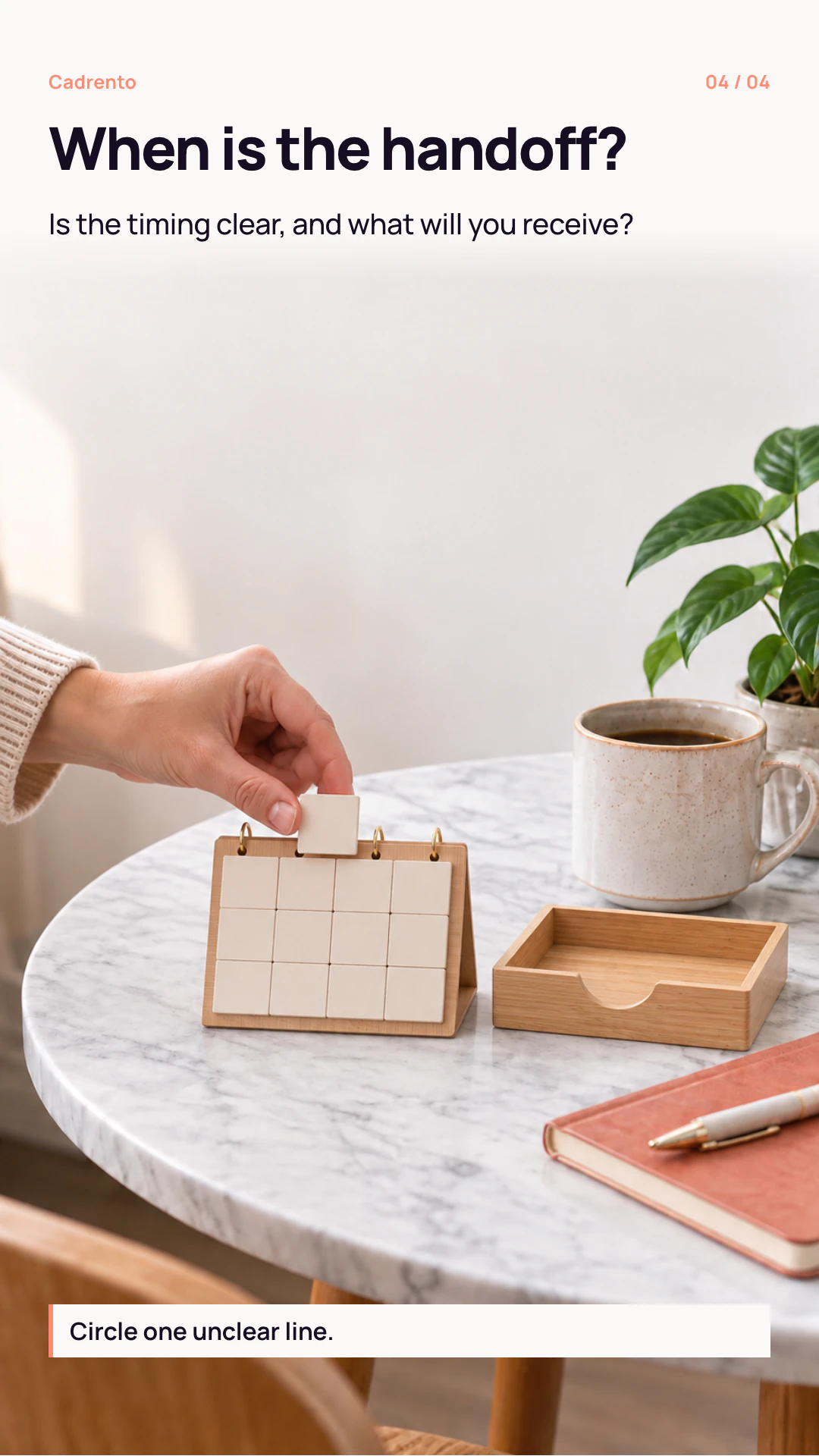
Ready to send your brief?

  1. A hand sets a small target icon beside a blank card on a tabletop.
    Frame 1 of 4What's the goal?

    Can the person you hire tell what you want the work to achieve?

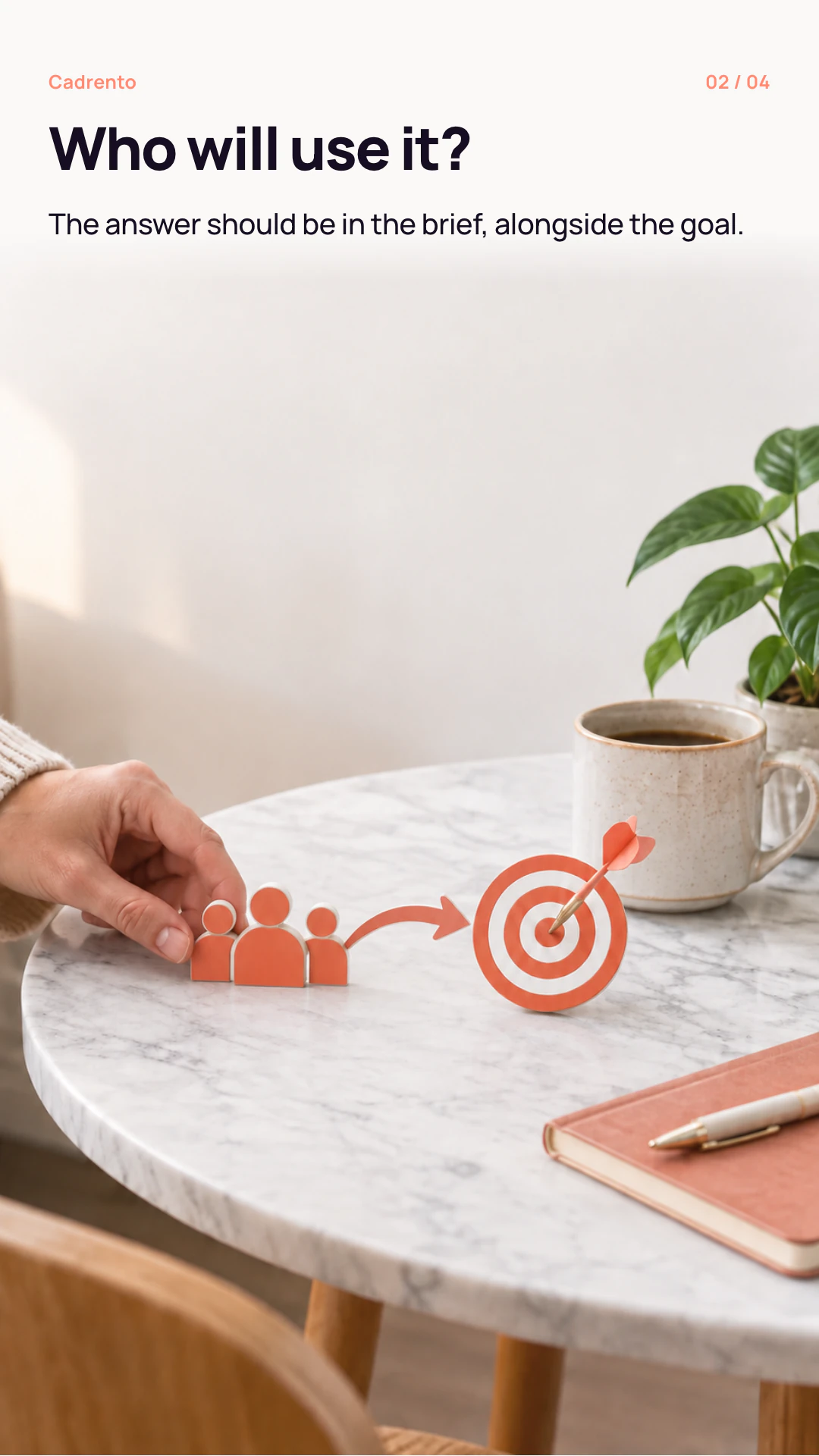
  2. A hand moves a small group-of-people icon toward a card with a target icon.
    Frame 2 of 4Who will use it?

    The answer should be in the brief, alongside the goal.

  3. Three plain task blocks sit inside a thin boundary beside the target and group icons.
    Frame 3 of 4What's in the job?

    Can they see what work you expect?

  4. A hand places a blank calendar tile beside an empty delivery tray on the tabletop.
    Frame 4 of 4When is the handoff?

    Is the timing clear, and what will you receive?

Read caption

Before you send a brief to someone you may hire, try reading it from their side. Asana lists the goal, audience, scope, and timeline as brief basics, not a required template. The handoff question is a practical final check.

Read text

What's the goal? Can the person you hire tell what you want the work to achieve?

Who will use it? The answer should be in the brief, alongside the goal.

What's in the job? Can they see what work you expect?

When is the handoff? Is the timing clear, and what will you receive?

Example call to action

Circle one unclear line.

10 / Article

How do you know what you’re hiring a contractor to do?

Read the full article

You ask a contractor for a proposal, and the first question is already hard: what exactly are you asking them to do? A short brief can give that conversation a starting point. Asana describes a project brief as a concise summary of goals, scope, timeline, and target audience. Treat that as a planning aid, not a rule you have to follow. For a service project, you can then separate three things: the need you describe, the work the contractor agrees to do, and the evidence you’ll use to check the result.

Describe the need in a short brief

Start with the situation that made you seek help. What needs to change, who will use the outcome, and when does the work need to happen? Write those answers in terms a contractor can ask questions about. If you are unsure about a boundary, say so instead of hiding it in a vague request. A brief can hold your goal, intended audience, timeline, and broad scope in one place; Asana presents those as useful brief elements. You can also name a constraint that matters to your decision, such as a required handoff date. The brief gives direction. It does not need to pretend that every task has already been decided.

Ask for a work list you can compare

Next, ask the contractor to turn that direction into a work list you can read line by line. For each part, look for a clear action and a clear deliverable. If a line says “support” or “setup,” ask what that means in this proposal. Will you receive a document, a configured account, a training session, or something else? The answer depends on the service and the agreement, so let the contractor describe the actual work. Compare that list with your brief: does it address the goal and audience you described? If a needed task is absent, raise it before you treat the proposal as complete. If something is included that you did not expect, ask why it belongs.

Agree on a check for each deliverable

Before work begins, decide how you will check each deliverable. Use an observable condition that you and the contractor can discuss, rather than a word such as “done” on its own. For a document, you might agree on its sections and the format in which it will be handed over. For a session, you might agree on its topic, length, and attendees. These are examples of checks you could choose, not a standard every service must use. Make room for questions about who reviews the result and how an issue will be reported. When the check cannot be written clearly, revisit the work list together. The promised result may still be too vague to evaluate.

The three pieces answer different questions. Your brief explains the need and gives the contractor context. The work list records what the contractor proposes to do and deliver. The final check gives you a way to compare the result with that agreement. They can be short, but they should point to the same outcome. If a detail changes, update the relevant piece so the next conversation starts from the current agreement.
Example call to action

Write one check for each deliverable.

Your business. Your own content.

Let’s discuss your content.

Tell us about your business and the formats you need. Scope and availability are confirmed before payment.

Email Cadrento

More industries